Volume 13, Issue 2, (2026) Jurnal Plastik Rekonstruksi
Dear Readers and Colleagues,
It is a privilege to present Volume 13, Number 2 (2026) of Jurnal Plastik Rekonstruksi. This issue brings together five contributions that reflect the breadth of contemporary plastic and reconstructive surgery, encompassing burn management, craniofacial reconstruction, genital reconstruction, and the emerging role of artificial intelligence in surgical practice.
Burn care remains a critical area of reconstructive surgery, where timely intervention and appropriate surgical techniques are essential to improving patient outcomes. This issue features two articles addressing distinct aspects of burn management. The first compares hospital stays among burn patients undergoing early and delayed tangential excision at Cipto Mangunkusumo Hospital, providing insights into the clinical implications of surgical timing. The second examines neglected third-degree burns of the lower limbs, emphasizing the technical considerations and functional implications of full-thickness skin grafting in complex reconstructive cases.
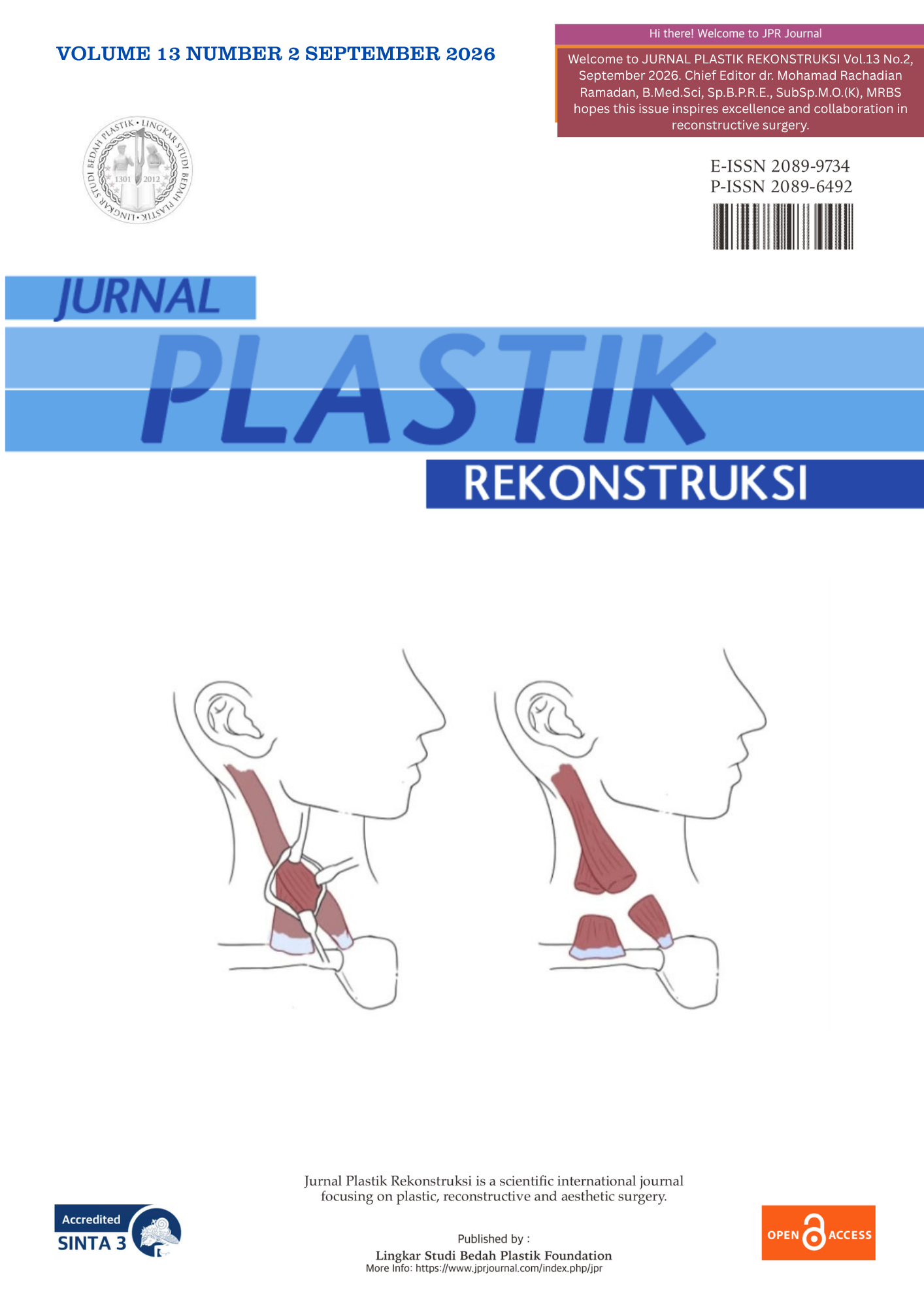
In the field of craniofacial surgery, a case report on congenital muscular torticollis treated with unipolar release contributes to the clinical discussion of surgical management for this condition, particularly in patients requiring operative intervention.
This issue also explores reconstructive surgery of the external genitalia through an observational study investigating erectile function following excision and reconstruction for penile sclerosing lipogranuloma in Southeast Indonesia. By examining functional outcomes alongside reconstructive intervention, the study highlights the importance of patient-centered evaluation in this specialized field.
Looking toward the future of surgical practice, the article Artificial Intelligence in Plastic and Hand Surgery: Potential or Provocation? invites critical reflection on the opportunities and challenges associated with integrating artificial intelligence into clinical decision-making, surgical education, and patient care. As technological advances continue to reshape medicine, thoughtful evaluation of their clinical value, ethical implications, and limitations remains essential.
Collectively, the contributions in this issue underscore the importance of evidence-informed practice, technical innovation, functional restoration, and critical engagement with emerging technologies. We hope these articles will stimulate professional dialogue, support clinical learning, and encourage further research in plastic and reconstructive surgery.
On behalf of the editorial team, I extend my sincere appreciation to the authors, reviewers, and editorial staff for their contributions to this issue. We are grateful to our readers for their continued engagement and support.
We hope you find this issue informative and valuable to your clinical practice and academic endeavors.
Sincerely,
dr. Mohamad Rachadian Ramadan, B.Med.Sci, Sp.B.P.R.E., SubSp.M.O.(K), MRBS
Editor-in-Chief
Jurnal Plastik Rekonstruksi
Published : 21-10-2026
Journal Info
 |
Editor-in-Chief: dr. Mohamad Rachadian Ramadan, B.Med.Sci, Sp.B.P.R.E., SubSp.M.O.(K), MRBS
Frequency: 2 issues per year (March & September)
National Accreditation: Sinta 3 Email: info@jprjournal.com
|
Video Article


Atmodiwirjo P, Ramadan MR, Triatmoko SE, Ralena NA. How to Harvest Radial Forearm Free Flap. J Plast Rekons 2020;7(1):7-9. DOI: https://doi.org/10.14228/jpr.v7i1.296
ACCREDITATION
Since October 2020, Jurnal Plastik Rekonstruksi has received Accreditation from the Ministry of Technology Research / National Research and Innovation Agency (SINTA 3)




 .